In power systems, cables, as important carriers of energy transmission, their performance directly relates to the stability and safety of power transmission. 2, 3, 4-core armoured AC copper
Power Cables (XLPE insulated) play an irreplaceable role in many fields such as industry, construction, and municipal administration with their excellent performance. The following will elaborate on this cable from two aspects: the product itself and general product information.
From the Perspective of the Product Itself
Specifications and Parameters
Specifications and parameters are the basis for cables to adapt to different power transmission scenarios. 2, 3, 4-core armoured AC
Copper Power Cables (XLPE insulated) have rich and precise settings in terms of specifications.
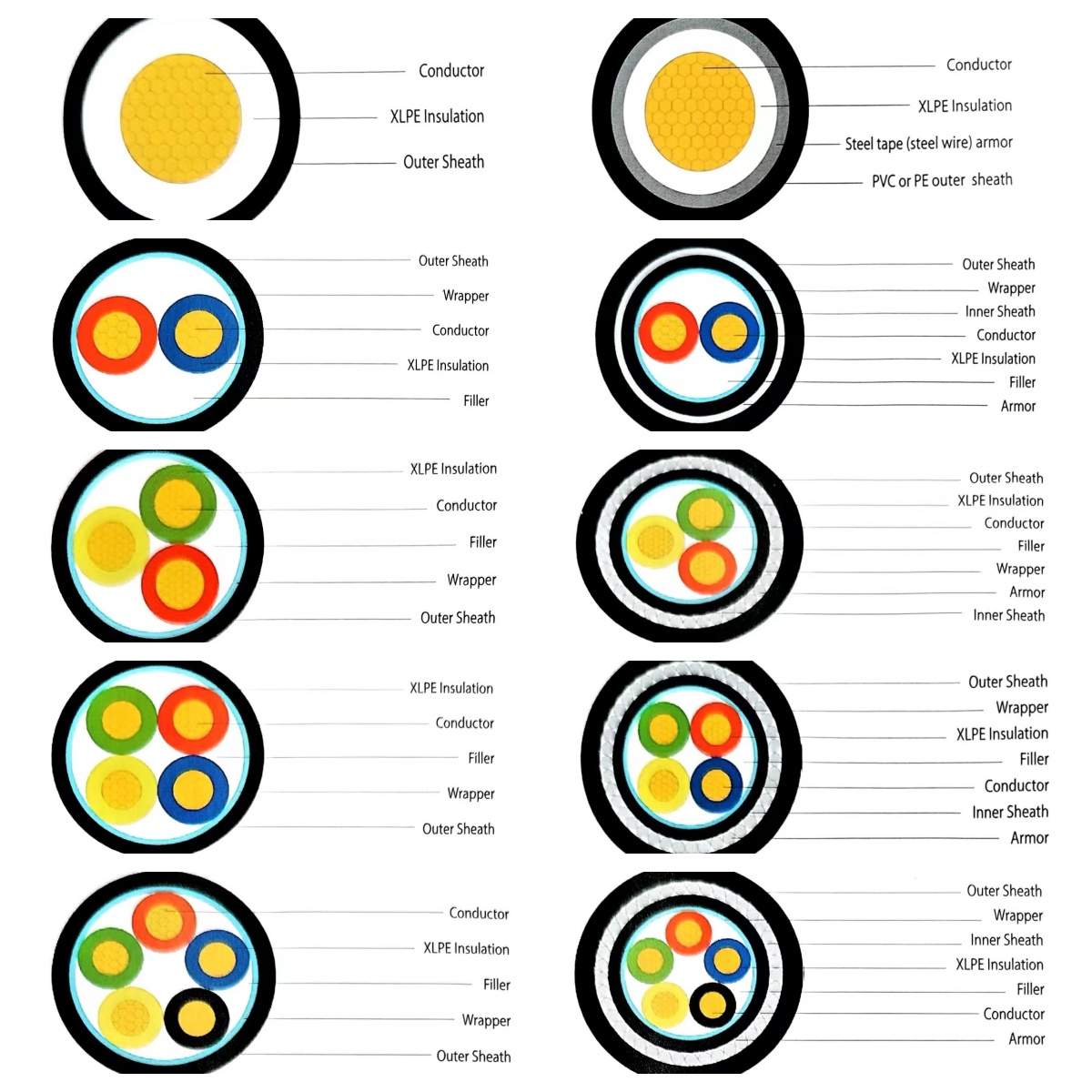
The number of cores of the cable is divided into 2-core, 3-core, and 4-core, meeting the needs of different circuits. 2-
Core Cables are mainly used in single-phase circuits, capable of one-way power transmission, and are suitable for scenarios with relatively simple power demand such as households and small commercial places. 3-core cables are specially designed for three-phase power circuits, which can transmit three-phase alternating current and provide stable power support for three-phase power equipment such as water pumps and fans. 4-core cables add a neutral wire to the 3-core ones, which makes them perform well in three-phase four-wire distribution systems. For example, the central air-conditioning distribution system in office buildings requires such cables containing neutral wires to ensure the balance and stability of the circuit.
In terms of cross-sectional specifications, it covers various sizes such as 4mm², 6mm², 10mm², 16mm², 25mm², and 35mm². Different cross-sectional areas correspond to different current-carrying capacities. The safe current-carrying capacity of 4mm² cables is about 25-32A, suitable for small and medium-power equipment; that of 6mm² cables is about 32-40A, which can meet the needs of more household appliances operating at the same time; that of 10mm² cables is about 40-50A, which can supply power to some small industrial equipment; that of 16mm² cables is about 50-63A, suitable for larger power industrial equipment; that of 25mm² cables is about 63-80A, which can be used for
Power Lines in factory workshops; that of 35mm² cables is about 80-100A, which can undertake large-scale power transmission tasks such as community distribution trunks.
In addition, the rated voltage of the cable is 0.6/1kV. This voltage level enables it to be widely used in low-voltage distribution systems, which can not only meet the needs of residential electricity, commercial electricity but also adapt to low-voltage power transmission in industrial production. At the same time, the insulation thickness of the cable varies according to different cross-sectional specifications. The insulation thickness of 4mm² cables is about 0.8mm, and as the cross-sectional area increases, the insulation thickness increases accordingly. The insulation thickness of 35mm² cables can reach 1.2mm to ensure good insulation performance under different current loads.
Characteristic Applications
2, 3, 4-core armoured AC copper power cables (XLPE insulated) show distinct characteristic applications in different scenarios due to their unique
Structure and Performance.
Due to their simple structure, 2-core cables are widely used in single-phase circuits. In household electricity, they are often used as branch lines to connect the main distribution box with the sub-switches in each room, providing power for small household appliances such as lighting fixtures, televisions, and refrigerators. In small commercial places such as convenience stores and small restaurants, 2-core cables can be used to connect equipment such as air conditioners and cash registers to meet their daily electricity needs. In addition, some small outdoor lighting facilities, such as branch lines of garden lights and street lights, also often use 2-core cables.
3-core cables play an important role in three-phase power equipment. Water pumps are common three-phase power equipment, and their operation requires stable three-phase alternating current. 3-core cables can accurately transmit power to water pumps to ensure their normal operation. Whether it is water pumping equipment in agricultural irrigation or water circulation systems in industrial production, they are inseparable from the support of 3-core cables. The same applies to fans. In factory ventilation systems and fresh air systems of central air conditioners, 3-core cables provide power for fans to ensure air circulation. In addition, three-phase power equipment such as mixers and compressors also rely on 3-core cables for power transmission.
4-core cables are indispensable in three-phase distribution systems that require neutral wires because they contain neutral wires. The central air-conditioning system in office buildings has high power and adopts three-phase four-wire distribution. The three phase wires in 4-core cables transmit electric energy, and the neutral wire plays a role in balancing the three-phase voltage to prevent equipment damage due to three-phase imbalance. In large shopping malls, many electrical equipment operate at the same time, and 4-core cables can ensure stable power supply, ensuring the normal operation of elevators, lighting, air conditioners and other equipment. In addition, the distribution systems of some industrial production lines also often use 4-core cables to meet complex power needs.
From the application of cross-sectional specifications, cables of 4mm² to 10mm² are suitable for small and medium-power equipment and indoor wiring. In residential buildings, indoor lighting lines and socket lines mostly use these specifications of cables. 4mm² cables can be used to connect some high-power electrical appliances in the kitchen, such as electric ovens and microwave ovens; 6mm² and 10mm² cables can meet the needs of multiple sockets for power supply at the same time. Cables of 16mm² to 35mm² are used for power supply of larger power industrial equipment and main line transmission. Large injection molding machines have extremely high power and require 16mm² or 25mm² cables to provide power; the distribution trunk of a community undertakes the power distribution task of the entire community, and 35mm² cables can meet its large-capacity power transmission needs.
At the same time, due to the good protection performance of the cable, it can also be used normally in some special environments. In underground direct burial scenarios, it can resist soil pressure and corrosion; when laid in tunnels, it can withstand various external impacts in the tunnel; in industrial plants, it can operate stably in the face of equipment vibration, oil pollution erosion, etc. A good example is that the workshop power line of a car factory uses 25mm² 4-core cables.
Material Styles
The material of the cable is the core factor determining its performance. 2, 3, 4-core armoured AC copper power cables (XLPE insulated) have been carefully considered in material selection to ensure high-quality products.
The conductor is made of 99.9% high-purity electrolytic copper, which has excellent conductivity with a resistance as low as 0.0172Ω/mm²·m, much lower than ordinary copper materials. High-purity electrolytic copper can reduce energy loss during current transmission and improve power transmission efficiency. At the same time, its good ductility makes the conductor not easy to break during processing, ensuring the mechanical strength and service life of the cable. Compared with other materials, high-purity electrolytic copper has better stability, and its conductivity will not decrease significantly during long-term use.
The insulation layer is made of cross-linked polyethylene (XLPE) and treated with a special cross-linking process. This treatment makes the molecular structure of XLPE more stable, with excellent temperature resistance, and can work normally in the temperature range of -40℃ to 105℃. In cold winters or hot summers, as well as in environments with high temperatures in industrial production, the insulation layer can maintain good insulation performance. In addition, XLPE also has strong aging resistance and chemical corrosion resistance. In harsh environments such as humidity, acid and alkali, it will not easily age or crack, and the insulation resistance is stable above 1000MΩ, which effectively reduces the risk of electric leakage and ensures the safety of power transmission.
The armor layer is made of 0.3-0.5mm thick hot-dip galvanized steel strip. The hot-dip galvanizing treatment forms a uniform and dense zinc layer on the surface of the steel strip. This zinc layer can play a good anti-corrosion role, preventing the steel strip from being corroded by external moisture, oxygen, etc., and extending the service life of the armor layer. The steel strip is tightly wrapped around the outside of the insulation layer through a spiral winding process. This winding method makes the steel strips interlock with each other, forming a solid protective layer and enhancing the mechanical strength of the cable. The armor layer can withstand a lateral pressure of 10kN/m and an impact force of 5kN, providing effective protection for the internal conductors and insulation layer when the cable is subject to external extrusion and collision, avoiding cable damage.
In terms of style, the cable has a black or gray cylindrical appearance with a smooth and flat surface. Cables with different core numbers and cross-sectional specifications differ in diameter. The more cores and the larger the cross-sectional area, the larger the diameter of the cable. Overall, the cable has a compact structure and good bending performance, which is convenient for laying and installation in different environments.
Production Process
Exquisite production process is the key to ensuring the excellent performance of 2, 3, 4-core armoured AC copper power cables (XLPE insulated), and each process is strictly controlled.
The production of the conductor is the first step. High-purity electrolytic copper rods are used as raw materials, and wire drawing is carried out by a wire drawing machine. During the wire drawing process, it is necessary to accurately control the size of the wire drawing die and the drawing speed to draw the copper rod into
Copper Wires with uniform diameter. The drawn copper wire also needs to be annealed. By heating, the internal structure of the copper wire is changed to improve its
Flexibility and conductivity. The annealed copper wires are stranded by a stranding machine to form a conductor with the required cross-sectional area. During stranding, the copper wires must be arranged closely and evenly to reduce the resistance of the conductor.
The extrusion of the insulation layer is an important link to ensure the insulation performance of the cable. A special extruder is used to heat and melt the XLPE material, and then evenly coat it on the surface of the conductor. During the extrusion process, it is necessary to strictly control the extrusion temperature, pressure, and speed. Too high a temperature will cause the decomposition of XLPE material, affecting the insulation performance; too low a temperature will cause defects such as bubbles and cracks in the insulation layer. The extruded
Insulated Wire core must be cooled and shaped in a cooling water tank to ensure the dimensional accuracy and surface quality of the insulation layer. Subsequently, the insulated wire core is cross-linked, usually by dry cross-linking or warm water cross-linking, so that the XLPE molecules form a three-dimensional network structure, thereby improving its temperature resistance, aging resistance and other properties.
For
Multi-Core cables, it is necessary to perform cabling treatment on the insulated wire cores. The cabling machine strands multiple insulated wire cores together according to a certain pitch. During stranding, fillers need to be added in the middle of the cable core to ensure the roundness of the cable core. The filler usually uses materials such as polypropylene rope, which has good corrosion resistance and flexibility. After cabling, a layer of non-woven fabric or polyester tape is wrapped around the cable core to play a fixing and isolating role.
The coating of the armor layer is a key process to enhance the protection performance of the cable. The hot-dip galvanized steel strip is wrapped around the outside of the cable core in a spiral winding manner by an armoring machine. During the winding process, it is necessary to accurately control the tension and winding angle of the steel strip to ensure that the steel strip is closely attached to the cable core without loosening, wrinkles, etc. The overlap of the steel strip must meet relevant standards to ensure the integrity and protection effect of the armor layer.
Finally, the cable is subjected to sheath extrusion. The sheath material is usually polyvinyl chloride (PVC) or polyethylene (PE), which is coated on the outside of the armor layer by an extruder to play a further protective role, preventing the armor layer from being damaged and corroded by the outside. The extruded cable must undergo cooling, coding, and other treatments. The coding content includes cable model, specification, length, production date, etc., which is convenient for identification and traceability.
During the production process, each process needs to undergo strict quality inspection. The diameter, resistance and other parameters of the conductor must meet the standards; the thickness, insulation resistance, voltage withstand performance, etc. of the insulation layer must be sampled and tested; the roundness of the cabled core and the overlap of the armor layer must also be checked. Only cables that pass all inspection items can enter the next process, ultimately ensuring that the cables leaving the factory are of stable and reliable quality.
From the Perspective of General Product Information
Packaging
To ensure that 2, 3, 4-core armoured AC copper power cables (XLPE insulated) are not damaged during storage and transportation, their packaging method has been scientifically designed and selected.
The packaging materials mainly use a combination of moisture-proof kraft paper and galvanized iron reels, with a wrapping film covering the outer layer. Moisture-proof kraft paper has good moisture-proof performance, and its dense fiber structure can effectively block moisture in the air from entering the cable, preventing the cable from being damp and affecting the insulation performance. At the same time, kraft paper also has a certain tensile strength, which can protect the cable from slight external collisions to a certain extent. The galvanized iron reel provides a solid support for the cable. The material of the iron reel is high-quality steel, which has good corrosion resistance after galvanizing treatment, preventing the iron reel from rusting in a humid environment. The size of the iron reel is designed according to the length and cross-sectional specification of the cable. Cables with small cross-sections and short lengths use iron reels with small diameters, and cables with large cross-sections and long lengths use iron reels with large diameters to ensure that the cables can be neatly wound on the iron reels, avoiding distortion and knotting.
The outer wrapping film is made of high-strength polyethylene material, which has good stretching performance and sealing performance. The wrapping film tightly wraps the moisture-proof kraft paper and the galvanized iron reel together to form a whole, further enhancing the moisture-proof and pressure-resistant performance of the packaging. At the same time, the wrapping film can also prevent the cable from falling off the iron reel during transportation, ensuring the integrity of the cable. During the packaging process, the staff will adjust the winding tension and number of layers of the wrapping film according to the actual situation of the cable to achieve the best packaging effect.
In addition, clear product information will be marked on the packaging, including the cable's model, specification, number of cores, cross-sectional area, length, production date, manufacturer, etc., which is convenient for customers to identify and manage during receipt and storage. For exported cables, corresponding international standards and certification marks will also be marked on the packaging to meet the import requirements of different countries and regions.
Transportation
To ensure that 2, 3, 4-core armoured AC copper power cables (XLPE insulated) can be delivered to customers in a timely and safe manner, there are various flexible transportation methods, which are optimized according to actual conditions.
Land transportation is one of the more commonly used transportation methods, suitable for medium and short-distance transportation. For large-volume orders, full vehicle transportation is usually adopted, that is, a truck only loads this cable, which can avoid mutual extrusion and collision between the cable and other goods, reducing the risk of damage. Full vehicle transportation also has the advantages of high transportation efficiency and fast arrival time, which can meet the urgent needs of customers. For small-volume orders, less-than-truckload transportation can be used, which 集中 loads multiple small batches of cables on a truck and transports them by means of loading, which can reduce transportation costs and is suitable for customers who are not particularly urgent about transportation time.
Maritime transportation is mainly suitable for long-distance transportation and export orders. Maritime transportation has the characteristics of large transportation volume and low cost, which can meet the transportation needs of large quantities of cables. During maritime transportation, the cables will be loaded in containers. Containers have good sealing and protection properties, which can resist wind, rain, salt spray and other erosion at sea, ensuring the quality of the cables. At the same time, container transportation is also convenient for loading, unloading and management of goods, improving transportation efficiency.
During transportation, logistics companies will take corresponding protective measures according to the characteristics of the cable and the transportation distance. For example, when loading cables, they will avoid placing the cables in humid, high-temperature environments or environments with corrosive substances; during transportation, they will regularly check the packaging of the cables to ensure no damage, water ingress and other problems. In addition, transportation insurance will be purchased for the cables to cope with possible unexpected situations and protect the interests of customers.
To allow customers to timely understand the transportation status of the goods, logistics companies will provide logistics tracking services. Customers can query the location of the cable and the estimated arrival time through the logistics tracking number. After the cable arrives, the staff will check the quantity, specifications and other information of the goods with the customer, and go through the signing procedures after confirmation.
Shipment
An efficient and accurate shipment process is an important link to ensure that customers receive 2, 3, 4-core armoured AC copper power cables (XLPE insulated) in a timely manner. Every step from order confirmation to goods shipment has strict regulations and operations.
After the customer places an order, the sales department will promptly transmit the order information to the warehouse and production department. Warehouse managers will first check the order information and check if there is inventory. For regular specification cables with inventory, they will be arranged for delivery within 24-48 hours. Before delivery, warehouse staff will carefully inspect the cables, including appearance, packaging, labels, etc., to ensure that the quality and specifications of the cables meet the order requirements. At the same time, the cables will be cut and packaged according to the order quantity and customer requirements. During cutting, the cut must be flat and the length must be accurate.
For special specification cables without inventory, the production department will formulate a production plan according to the order requirements and arrange production. During the production process, operations will be carried out in strict accordance with production processes and quality standards to ensure the quality of the cables. After production is completed, the cables that pass the quality inspection will be sent to the warehouse, and the warehouse staff will carry out outbound processing in accordance with the above process.
Before shipment, the staff will enter the relevant information of the cable into the system to generate a delivery note, which includes customer information, cable model, specification, quantity, shipment date, logistics company, etc. Subsequently, the delivery note and the cable will be handed over to the logistics company, and the relevant consignment procedures will be handled. At the same time, the shipment information will be promptly notified to the customer, including the logistics company name, logistics tracking number, estimated arrival time, etc., so that the customer can prepare for receipt.
To ensure the accuracy of shipment, the warehouse will establish a strict outbound inspection system, and sample inspection will be carried out on each batch of cables. The inspection items include conductor resistance, insulation resistance, voltage withstand performance, etc. Only cables that pass the inspection can be shipped. In addition, records will be made of the shipment process, including shipment time, quantity, handler, etc., for traceability.
If the customer has special requirements for the shipment time, such as expedited shipment, the sales department will communicate with the production department and the warehouse, coordinate resources, and try to meet the customer's needs. In special cases, such as delays in shipment due to force majeure factors such as natural disasters and traffic jams, the customer will be promptly communicated with, the situation will be explained, and corresponding remedial measures will be taken.
Samples
To allow customers to fully understand the performance and quality of 2, 3, 4-core armoured AC copper power cables (XLPE insulated) before purchasing, the manufacturer provides sample services for customers to test and evaluate.
Customers can specify parameters such as the number of cores, cross-sectional specifications, and length of the cable according to their actual needs, and the manufacturer will produce samples according to the customer's requirements. The length of the sample is usually between 1-10 meters, and customers can choose the appropriate length according to the test needs. For samples of regular specifications, the manufacturer will complete production and send them out within 3-5 working days; for samples of special specifications, the production time will be extended according to the actual situation, but the customer will be promptly communicated with to inform the expected sample delivery time.
When the sample is sent out, a detailed test report will be attached. The test report includes various performance indicators of the sample, such as
Conductor Material and purity, temperature resistance range of
Insulation Material, insulation resistance, voltage withstand performance, thickness of armor layer and impact resistance, etc. These data are obtained through professional testing equipment and strict testing procedures, and have high accuracy and authority. Customers can understand the performance parameters of the sample through the test report, compare them with their own usage needs, and judge whether the cable meets the requirements.
Samples are usually provided free of charge, but customers need to bear the transportation cost of the samples. For customers with long-term cooperation intentions or large orders, the manufacturer may waive the transportation cost. After the sample is sent out, the manufacturer will track the sample delivery status and pay attention to the customer's test feedback. If the customer has any questions about the sample performance or test results, the technical staff will provide professional answers and explanations to help the customer better understand the product.
After-sales Service
A sound after-sales service system is an important guarantee for customers to use 2, 3, 4-core armoured AC copper power cables (XLPE insulated) with confidence. The manufacturer provides comprehensive after-sales support to solve various problems encountered by customers in the process of using the cables.
The product provides a 2-year warranty service. During the warranty period, if the cable has quality problems caused by non-human factors, such as insulation breakdown, conductor damage, etc., the manufacturer will provide free replacement of new cables or maintenance services. When a quality problem occurs, the customer can contact the after-sales department through the official phone, email, or online platform, and provide relevant information such as the product model, batch number, and problem description. The after-sales staff will record the problem and arrange for technical personnel to deal with it.
The professional technical team of the manufacturer can provide technical guidance and support for customers. If customers encounter problems in the process of cable installation, such as unclear installation methods, unreasonable layout, etc., they can consult the technical team. The technical team will provide detailed installation instructions and suggestions according to the actual situation of the customer, and even send technical personnel to the site for installation guidance if necessary to ensure that the cable is installed correctly and safely.
In addition, the after-sales department will track the use of the cable regularly. After the cable is used for a period of time, the after-sales staff will contact the customer to understand the operation status of the cable, collect feedback on product performance and use, and provide relevant maintenance suggestions. For customers with large projects, the manufacturer can also provide regular on-site inspection services to check the cable's operation status, detect potential problems in advance, and take preventive measures.
If there is a dispute between the customer and the manufacturer regarding product quality or after-sales service, both parties will resolve it through friendly negotiation. If the negotiation fails, they can resort to legal channels in accordance with relevant laws and regulations to protect their legitimate rights and interests. The manufacturer has always adhered to the principle of customer first, continuously improving the after-sales service system, and striving to provide customers with satisfactory services.


 English
 Español
 Portugues
 Pусский
 العربية
 ไทย
ไทย Türk dili
 Indonesia
 Tiếng Việt



 Téléphone
 E-mail