I. Product - Related Information
(I) Specifications and Parameters
This product is a rigid Vgv copper - core PVC cable, supplied in rolls, covering three specifications: 3X1.5mm², 3X2.5mm², and 3X4mm², and is suitable for low - voltage fixed laying power transmission scenarios.
In terms of structural specifications, the 3 - core design is its prominent feature. Each core corresponds to a different conductive function, adapting to three - phase power transmission needs. There are differences in the current - carrying capacity of different cross - sectional area specifications. The current - carrying capacity of the 3X1.5mm² cable is about 10 - 16A, the 3X2.5mm² is about 16 - 25A, and the 3X4mm² is about 25 - 32A. This difference in current - carrying capacity allows them to be adapted to electrical equipment of different powers respectively.
As a
Rigid Cable, it has a certain hardness and a relatively fixed bending radius. The minimum bending radius of 3X1.5mm² and 3X2.5mm² is usually not less than 6 times the outer diameter of the cable, and that of 3X4mm² is not less than 8 times the outer diameter of the cable. This characteristic ensures structural stability during fixed laying. Cables supplied in rolls are generally 100 meters per roll, and some can be customized to special lengths such as 50 meters according to customer needs, which can meet the length requirements of different laying scenarios.
(II) Characteristic Uses
Due to its own specifications and performance characteristics, this cable has a wide range of application scenarios. In home decoration, the 3X1.5mm² specification is very suitable for lighting circuits. It can stably supply power to lighting fixtures in the living room, bedroom and kitchen. The 3X2.5mm² can be used for ordinary socket circuits, such as power supply for sockets of commonly used household appliances such as TVs, refrigerators and washing machines. The 3X4mm² can meet the power needs of high - power household appliances such as air conditioners and electric water heaters, ensuring the stable operation of these energy - intensive equipment.
In terms of wiring for small industrial equipment, the 3X2.5mm² specification can be used as the power supply line for some low - power equipment such as conveyors and small machine tools. For small compressors and other equipment with certain power requirements, the 3X4mm² specification is more suitable. In the branch laying of commercial places, such as shelf lighting in small supermarkets and power supply for cash register equipment, 3X1.5mm² and 3X2.5mm² can play a role. For power supply of air conditioners, printers and other equipment in small offices, 3X4mm² can provide stable power support.
In addition, this cable can also meet the needs of power supply for small instruments in laboratories and lighting and simple equipment in small warehouses with its stable performance. Its fixed laying characteristic enables it to maintain a stable power transmission state in these scenarios for a long time.
(III) Material and Style
Conductor Material
The
Cable Conductor is made of pure copper material. Pure copper has excellent electrical conductivity, which greatly reduces losses during power transmission and improves power transmission efficiency. At the same time,
Pure Copper Conductors have good mechanical strength, can withstand a certain amount of tension and pressure during fixed laying, and are not easy to break or be damaged, ensuring the service life of the cable.
Moreover, pure copper has good oxidation resistance, is not easy to be oxidized and corroded in conventional environments, and can maintain good electrical conductivity for a long time. After precision processing, the surface of the conductor is smooth, which reduces friction with the insulation layer and helps protect the integrity of the insulation layer.
Insulation and Sheath Layer Materials
Both the insulation layer and the sheath layer are made of polyvinyl chloride (PVC) material. This material has excellent insulation performance, can effectively block current, prevent current leakage, and ensure electrical safety. PVC material has good wear resistance, which can resist external friction and collision during cable laying and use, and reduce damage to the internal structure.
It also has prominent flame - retardant performance. When encountering an open flame, it can slow down the burning speed and reduce the risk of fire. At the same time, PVC material has stable performance in conventional temperature environments (-15℃ to 60℃), and can meet the environmental requirements of most
Indoor fixed laying scenarios. In addition, the cost of PVC material is relatively low, making the cable as a whole have high cost - performance.
Style Design
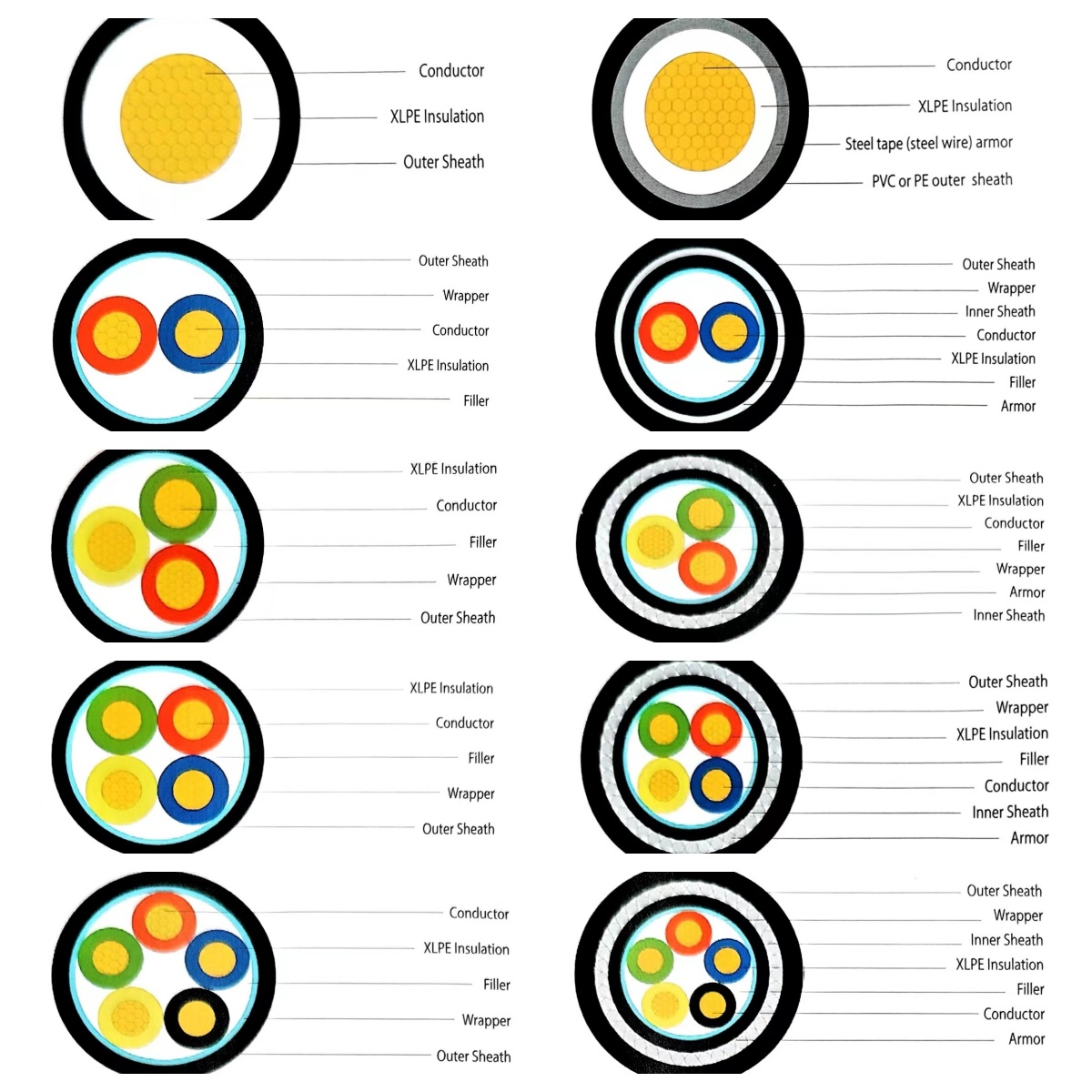
The cable is of rigid design with moderate overall hardness and is not easy to deform. This rigid characteristic makes it very suitable for fixed laying and can maintain a stable shape in hidden laying positions such as inside walls and under floors. The 3 - core structure cables are arranged neatly, closely combined in the sheath, with a round appearance and a smooth surface.
Cables of different specifications differ in outer diameter. 3X1.5mm² has a smaller diameter and 3X4mm² has a larger diameter, which can be distinguished by visual observation. The roll packaging style makes the cable take up little space during storage and transportation, and is easy to cut and use, which can be flexibly cut according to the actual laying length.
(IV) Production Process
Conductor Manufacturing
For conductor manufacturing, pure copper raw materials are first strictly screened to ensure that their purity meets the standard. After that, the pure copper material is made into copper rods through smelting, billet casting and other processes. The quality of copper rods directly affects the performance of subsequent conductors. The copper rod is drawn into
Copper Wires of the required diameter through wire drawing equipment. During the wire drawing process, the wire drawing speed and mold size must be precisely controlled to ensure that the diameter of the copper wire is uniform and the surface is smooth.
Subsequently, a single copper wire is stranded to form a conductor according to the specified stranding method. The conductors of 3X1.5mm², 3X2.5mm² and 3X4mm² are respectively stranded by copper wires of corresponding quantity and diameter. During the stranding process, it is necessary to ensure that the copper wires are arranged closely and with uniform tension to enhance the mechanical strength and conductive performance of the conductor. After stranding, the conductor is annealed to eliminate internal stress and further improve the
Flexibility and conductivity of the conductor.
Insulation Layer Extrusion
Before extruding the insulation layer, the PVC material must be pretreated to remove impurities and moisture to avoid affecting the insulation effect. The treated PVC material is fed into the extruder and melted and plasticized at high temperature. The melted PVC material is evenly coated on the surface of the conductor through an extrusion die to form an insulation layer.
During the extrusion process, it is necessary to strictly control the extrusion temperature, pressure and speed to ensure that the thickness of the insulation layer is uniform. The thickness of the insulation layer of 3X1.5mm², 3X2.5mm² and 3X4mm² meets the requirements of the corresponding specifications respectively. At the same time, it is necessary to ensure that the surface of the insulation layer is smooth, without bubbles, cracks and other defects, and is closely combined with the conductor.
Cabling Process
Cabling is to strand three
Insulated Wire cores together according to a certain stranding direction and pitch. During stranding, it is necessary to ensure that the three wire cores are in accurate positions, arranged neatly, and the tension is consistent to avoid loosening and twisting of the wire cores. During the stranding process, filling ropes can be filled in the gaps as needed to make the cabled cable structure more round and stable and enhance its anti - extrusion performance.
After cabling, the cable is inspected for appearance to ensure that the wire cores are stranded evenly without obvious bulges or depressions.
Sheath Extrusion and Finished Product Inspection
When extruding the sheath, PVC material is added to another extruder, melted and evenly coated on the outer layer of the cabled wire core through a die to form a sheath layer. It is necessary to control the thickness of the sheath layer. Cables of different specifications have different sheath layer thicknesses to ensure sufficient protection strength.
The finished product inspection link is crucial. The appearance, size, insulation performance of the cable, etc. must be fully inspected. The appearance inspection checks whether the sheath is smooth and has no damage; the size measurement checks whether the conductor cross - sectional area, insulation layer and sheath layer thickness meet the specifications; the insulation performance test ensures that the insulation effect meets the standard through voltage withstand test and other methods. Only cables that meet all indicators can be packaged in rolls.
II. General Product Information
(I) Packaging
Packaging Materials
The cable is packaged in rolls, and the packaging materials mainly include hard paper tubes and plastic films. The hard paper tube, as a reel, can support the cable to keep in a rolled state and prevent the cable from being deformed during storage and transportation. The hard paper tube is made of solid material and has a certain compressive capacity. The diameter of the hard paper tube for 3X1.5mm² and 3X2.5mm² cables is relatively small, and that for 3X4mm² is slightly larger.
The outer layer of the cable roll is wrapped with a layer of plastic film, which can effectively prevent moisture and dust and avoid the cable from being polluted by the external environment. In some cases, a woven bag is put over the plastic film to enhance the wear resistance and extrusion resistance of the package, which is especially suitable for long - distance transportation.
Packaging Methods
During packaging, the cable is first neatly wound on the hard paper tube. During the winding process, appropriate tension is maintained to ensure that the cable is arranged closely without loosening. After winding, the entire cable roll is wrapped tightly with plastic film, which should be close to the surface of the cable without gaps. For cable rolls that need long - distance transportation or special protection, a woven bag is put on, and the woven bag is fixed firmly with a rope.
A label is pasted in a prominent position of the package, indicating product name, specification (such as 3X1.5mm²), length, production date, batch number and other information, which is convenient for customers to identify and check. At the same time, warning signs such as "Moisture Proof" and "Handle with Care" are also printed on the label.
(II) Transportation
Transportation Methods
Different transportation methods can be selected according to the transportation distance and order quantity. Short - distance transportation (such as in the city and surrounding areas) usually uses small trucks. This transportation method is flexible and convenient, can quickly deliver goods to the destination, and is suitable for small - batch orders.
For medium - and long - distance transportation with large batches, large freight trucks can be selected, which have a large loading capacity and can reduce transportation costs. For some urgent orders, if the customer's location has convenient transportation, express transportation such as SF Express and Deppon can also be used, which can shorten the transportation time, but the cost is relatively high.
Transportation Precautions
During transportation, it is necessary to avoid severe collision and extrusion of the cable roll. When loading, the cable rolls should be placed neatly and separated by buffer materials (such as foam boards) to prevent mutual friction and collision. For cable rolls placed in stacks, the stacking height should not be too high. The stacking layers of 3X1.5mm² and 3X2.5mm² are generally no more than 5 layers, and that of 3X4mm² is no more than 3 layers to prevent the bottom cable rolls from being damaged by pressure.
Moisture - proof measures should be taken during transportation to avoid the cable being 淋湿 by rain. A tarpaulin can be covered on the transport vehicle. At the same time, the cable roll should be prevented from being exposed to sunlight for a long time to prevent the PVC material from aging due to high temperature. During transportation, the driver should drive smoothly and reduce sudden braking and sharp turns to ensure the stability of the cable roll.
(III) Shipment
Shipment Process
After the customer places an order, customer service personnel will check the order information in a timely manner, including product specifications, quantity, receiving address, contact information, etc., to ensure accuracy. After checking, the warehouse is notified to prepare the goods. Warehouse managers retrieve cable rolls of corresponding specifications and quantities from the inventory according to the order information, count and inspect their appearance to confirm that there is no damage or quality problem.
After the goods are prepared, the cable rolls are transported to the shipping area and re - reinforced according to the packaging requirements (if necessary). At the same time, contact the transport company, inform the shipping information, and arrange transport vehicles. When the transport vehicle arrives, the cable rolls are loaded onto the vehicle, and relevant shipping procedures are handled, such as filling in waybills and delivery orders. After shipment, customer service personnel will promptly inform the customer of the waybill number, transport company information, etc., to facilitate the customer to track the logistics.
Shipment Time
When the inventory is sufficient, for regular orders (such as no more than 10 rolls per specification), shipment is usually completed within 1 - 2 working days after the customer places the order. If the order quantity is large (such as more than 20 rolls per specification), it is necessary to prepare and sort the goods, and the shipment time will be extended to 2 - 3 working days.
In case of special circumstances, such as customers customizing cables of special lengths, which need to be re - cut and packaged, the shipment time depends on the customized quantity, generally 3 - 5 working days. During holidays, the shipment time will be postponed accordingly, and customer service personnel will inform the customer in advance.
(IV) Samples
Sample Provision
To facilitate customers to understand product quality and performance, the company provides sample services. Customers can put forward sample requirements to sales personnel and specify the specifications of the required samples. The company provides samples of 3X1.5mm², 3X2.5mm² and 3X4mm² free of charge. The length of the samples is generally 1 - 2 meters, which can meet the customer's needs for checking the appearance, material and rigidity of the cable.
The material and process of the samples are exactly the same as those of the bulk products, which can truly reflect the actual situation of the products. Customers only need to bear the express fee of the samples, and the company can assist in selecting a suitable express method.
Sample Delivery
After the samples are prepared, they will be packaged with small - sized hard paper tubes, and the outer layer is wrapped with plastic film to prevent damage during transportation. The sample specification, company name and contact information are marked on the package. A well - known and fast express company such as SF Express is selected for delivery.
After the samples are sent, the sales personnel will promptly inform the customer of the express waybill number and remind the customer to pay attention to the receipt. Samples in domestic areas can generally be delivered within 1 - 3 days, and it may take 4 - 5 days in remote areas.
(V) After - sales Service
Quality Assurance
The company provides quality assurance for this cable product, with a warranty period of 12 months from the date when the customer receives the product and accepts it. During the warranty period, if the product fails due to its own quality problems (such as conductor breakage, insulation layer damage and other non - human factors), the company will provide customers with free return and exchange services.
If the product has problems due to improper use by the customer (such as using beyond the current - carrying capacity, damage caused by external extrusion, etc.), the company can provide maintenance suggestions, but does not assume the responsibility of free maintenance or return and exchange.
After - sales Service Process
If a customer finds a product quality problem during use, they can feedback through the company's customer service phone, email, etc. After receiving the feedback, customer service personnel will record customer information, product specifications, problem descriptions in detail, and arrange technical personnel to connect within 24 hours.
Technical personnel will communicate with customers to understand the specific situation, and ask customers to provide problem photos or videos if necessary. After verification, determine the cause of the problem. If it is a quality problem, negotiate with the customer on return and exchange matters and arrange logistics to pick up the goods; if it is not a quality problem, provide corresponding solutions and suggestions.
Technical Support
The company's technical team can provide customers with professional technical support. In the cable selection stage, technical personnel will recommend cables of appropriate specifications according to the customer's use scenario and power consumption; during the laying process, if customers encounter problems such as laying methods and bending treatment, they can consult technical personnel at any time to get professional guidance.
At the same time, the company will provide customers with product - related technical materials, such as laying guides and safety use instructions, to help customers use the products correctly. Regular return visits to customers are conducted to understand the product use, collect customer opinions and suggestions, and continuously improve products and services.


 English
 Español
 Portugues
 Pусский
 العربية
 ไทย
ไทย Türk dili
 Indonesia
 Tiếng Việt



 Téléphone
 E-mail