I. From the Perspective of the Product Itself
(1) Specification Parameters
The 3x240mm² aluminum
Core XLPE low-voltage under
Ground Cable has rigorous and clear definitions in terms of specification parameters, which together determine the performance and application scope of the cable.
In terms of rated voltage, the cable is clearly 0.6/1KV. This voltage level enables it to operate stably in low-voltage power systems and is suitable for low-voltage power distribution links from the power generation end to the electricity consumption end, such as branch transmission in urban distribution networks and power distribution in industrial parks. 0.6KV represents the phase voltage of the cable, and 1KV represents the line voltage. This voltage setting not only meets the needs of most low-voltage electrical equipment but also ensures the safety and efficiency during power transmission.
The conductor specification is one of the core parameters of the cable. It uses 3
Aluminum Conductors with a cross-sectional area of 240mm². The 240mm² cross-sectional area is accurately calculated to ensure good electrical conductivity while withstanding a certain current load. The 3 conductors in the
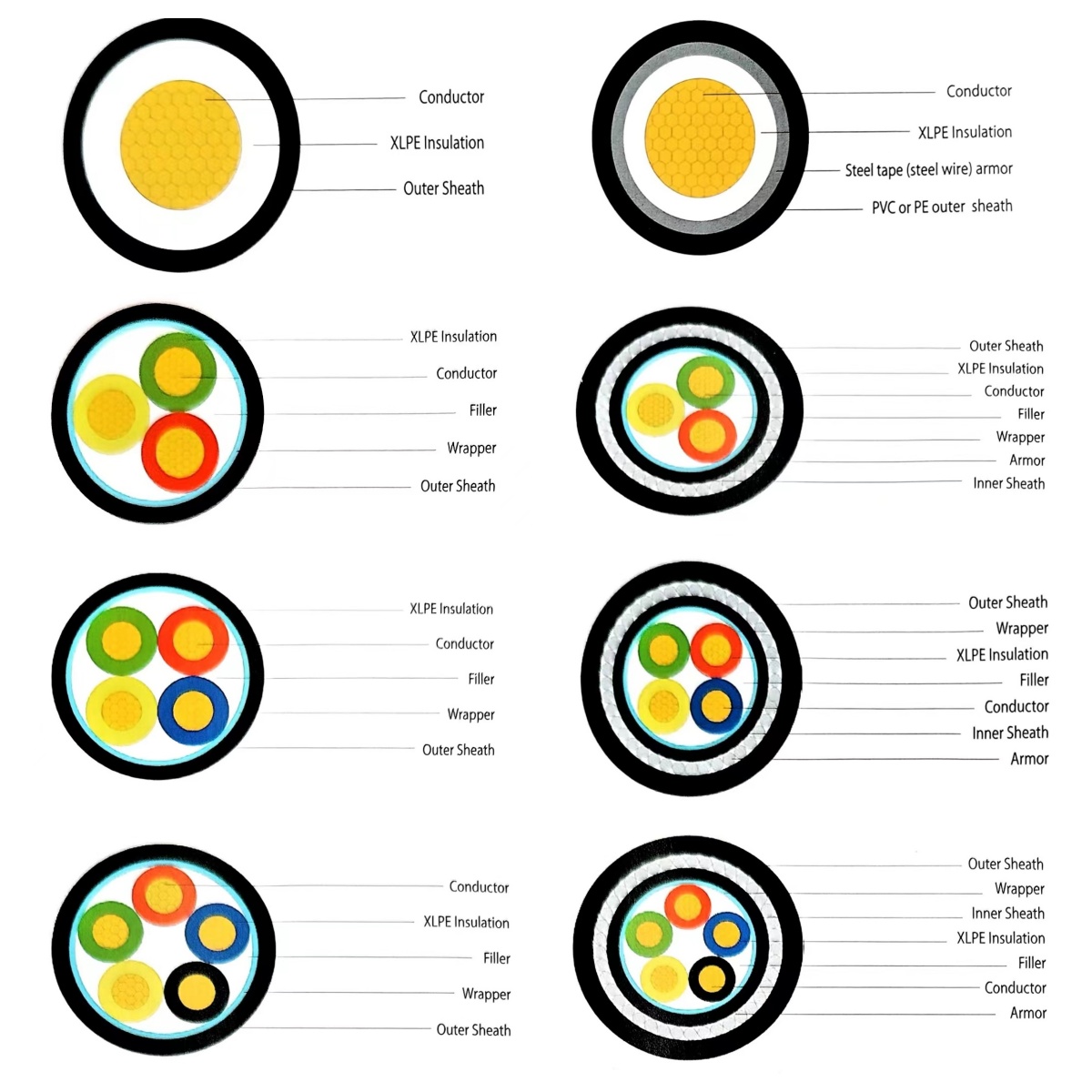
Multi-Core design correspond to the A, B, and C phases of the three-phase electricity respectively. This design conforms to the standards of the three-phase AC power system and can realize stable power transmission. In terms of the diameter of the conductors, precise processing ensures the dimensional consistency of each conductor, thereby ensuring the balanced distribution of current among the phases.
The parameters of the insulation layer are also crucial. The cable uses XLPE (cross-linked polyethylene) as the
Insulation Material. The thickness of the XLPE insulation layer is strictly designed according to the rated voltage and service environment of the cable. Generally speaking, for
0.6/1kv Cables, the thickness of the insulation layer can effectively prevent current leakage and ensure the insulation performance of the cable. XLPE material has extremely high insulation resistance, can withstand high electric field strength, and its insulation performance is not easy to age during long-term use, thus maintaining stable electrical performance.
The sheath layer is made of PVC (polyvinyl chloride) material, and its thickness is also carefully designed. The
PVC Sheath layer not only protects the internal conductors and insulation layer but also has certain mechanical strength and environmental resistance. An appropriate thickness of the sheath layer can ensure that the cable can resist external mechanical impact, wear, chemical corrosion, etc. during laying, transportation, and use.
In addition, the overall outer diameter of the cable is also an important specification parameter, which affects the laying method and laying space of the cable. During design, it is necessary to comprehensively consider the sizes of the conductor, insulation layer, and sheath layer to ensure that the overall outer diameter of the cable is within a reasonable range, so as to facilitate laying in underground pipes, trenches, and other environments. At the same time, the weight of the cable is also a parameter to be considered, which affects the difficulty and cost of transportation and laying.
(2) Characteristic Uses
The 3x240mm² aluminum core XLPE low-voltage underground cable has a wide range of characteristic uses in many fields due to its unique performance.
In the construction of urban distribution networks, this cable plays an important role. With the accelerating urbanization process, the demand for electricity in cities is increasing. Compared with
Overhead Lines,
Underground Cables have the advantages of not occupying ground space, being less affected by weather, and having high safety. This cable can be used as a branch of the urban distribution network to transmit power from substations to various residential quarters, commercial areas, and industrial zones, meeting the electricity needs of different urban areas. For example, in newly built residential quarters, the use of this cable for underground laying can avoid overhead lines affecting the beauty of the community and the safety of residents' lives, while ensuring the stability of power supply.
Industrial parks are another important application scenario for this cable. In the industrial production process, a large amount of electricity is often needed to drive various production equipment, and the requirements for the reliability and stability of power supply are extremely high. The 3x240mm² specification of this cable can meet the power needs of medium and large industrial equipment, such as large machine tools and production lines. Its XLPE insulation layer and PVC sheath layer can resist corrosion from oil stains, chemical gases, etc. in the industrial environment, ensuring the normal operation of the cable in harsh industrial environments. In the power distribution system of industrial parks, this cable can connect the power distribution room with various production workshops to realize efficient power transmission.
In municipal engineering, this cable also has unique uses. For example, in the urban road lighting system, it is necessary to transmit power from the distribution box to each street lamp. The use of this cable for underground laying can prevent the line from being damaged when exposed to the ground and ensure the normal power supply of the street lamps. In municipal facilities such as urban sewage treatment plants and waterworks, this cable can provide stable power for various water pumps, motors, and other equipment, ensuring the normal operation of municipal facilities.
The agricultural field is also inseparable from the support of this cable. In modern agricultural production, greenhouses, irrigation systems, etc. all need power supply. This cable can be buried underground in farmland to transmit power to various agricultural electrical equipment, meeting the electricity needs of agricultural production. Its moisture resistance and corrosion resistance can adapt to the soil environment of farmland, ensuring the reliability of power supply and providing power guarantee for a good harvest in agricultural production.
In addition, this cable can also play an important role in some temporary electricity scenarios. For example, when temporary power supply is needed for large outdoor activities, construction sites, etc., this cable can be laid as a temporary cable, and its portability and reliability can meet the needs of temporary electricity use. After the event or the completion of the project, the cable can also be recycled and reused to improve resource utilization.
(3) Material and Style
The 3x240mm² aluminum core XLPE low-voltage underground cable has been carefully considered in material selection and style design to meet different usage needs.
In terms of materials, aluminum is used as the raw material for the conductor. Aluminum has good electrical conductivity. Although its conductivity is slightly inferior to that of copper, the price of aluminum is relatively low, and its density is small, which makes the weight of the cable lighter and reduces the cost of transportation and laying. At the same time, aluminum has good ductility and plasticity, which is convenient for processing into conductors of various specifications. In order to further improve the performance of the aluminum conductor, its surface is usually treated, such as coating an anti-oxidation coating to prevent aluminum from oxidizing in the air and ensure the long-term stability of the conductor's electrical conductivity.
The insulation layer is made of XLPE material, which has many excellent properties. XLPE is obtained by cross-linking polyethylene. After cross-linking, the molecular structure of polyethylene changes from linear to network, thus significantly improving its heat resistance, mechanical strength, and chemical corrosion resistance. Compared with traditional polyethylene insulation materials, XLPE has a higher working temperature and can work normally in an environment of -50℃ to 90℃, which enables the cable to maintain good insulation performance in high or low temperature environments. In addition, XLPE also has excellent anti-aging performance, which can resist the influence of ultraviolet rays, oxygen, humidity, and other factors for a long time, and prolong the service life of the cable.
The sheath layer is made of PVC material. PVC is a commonly used plastic material with good mechanical properties, chemical corrosion resistance, and flame retardancy. The PVC sheath layer can effectively protect the internal conductors and insulation layer of the cable from external mechanical damage, moisture, and chemical erosion. At the same time, PVC material has good processing performance and can be made into sheath layers of different thicknesses and shapes through extrusion molding and other processes to adapt to different use environments. In order to improve the performance of the PVC sheath layer, some additives can be added to it, such as flame retardants and antioxidants, to further enhance its flame retardancy and anti-aging properties.
In terms of style, the cable is a multi-core stranded style. The 3
Aluminum Conductors are stranded together according to a certain stranding method. This design can reduce the bending stress of the cable during laying and use, and improve the
Flexibility and fatigue resistance of the cable. At the same time, the
Stranded Cable structure is more compact, occupies less space, and is convenient for laying in narrow spaces such as underground pipes. In addition, the appearance of the cable is usually black or gray, which can not only play a certain role in shading, reducing the aging effect of sunlight on the cable but also blend with the underground environment without affecting the beauty of the environment.
In addition to the conventional style, according to different usage needs, the cable can also be customized into some special styles. For example, for places with fire protection requirements, a flame-retardant PVC sheath layer can be used; for places with waterproof requirements, a waterproof coating can be added outside the sheath layer or a waterproof structure design can be adopted. These special styles of cables can meet the personalized needs of different scenarios and improve the applicability of the cable.
(4) Production Process
The production process of 3x240mm² aluminum core XLPE low-voltage underground cable is complex and sophisticated, and each link has an important impact on the quality of the cable.
Conductor production is the first step in cable production. First, the aluminum raw materials need to be inspected to ensure that their purity and various performance indicators meet the requirements. Then, the aluminum ingot is heated to a molten state, and the aluminum rod is made through a continuous casting process. The aluminum rod is drawn by a wire drawing machine to gradually become thinner, forming an
Aluminum Wire with the required diameter. During the wire drawing process, it is necessary to control the drawing speed and temperature to ensure the dimensional accuracy and mechanical properties of the aluminum wire. The drawn aluminum wire needs to be annealed. Through the heating and cooling process, the internal stress of the aluminum wire is eliminated, and its flexibility and electrical conductivity are improved. Finally, multiple
Aluminum Wires are stranded together according to certain rules to form an aluminum conductor with a cross-sectional area of 240mm². During the stranding process, the roundness and tightness of the conductor must be ensured.
The extrusion of the insulation layer is one of the key links in cable production. First, the
XLPE Insulation Material is pretreated to remove impurities and moisture. Then, the treated XLPE material is added to the extruder, and the material is melted by heating. The molten XLPE material is uniformly coated on the surface of the aluminum conductor through a mold under the pressure of the extruder to form an insulation layer. During the extrusion process, it is necessary to accurately control the extrusion temperature, pressure, and speed to ensure that the insulation layer has uniform thickness, a smooth surface, and is tightly bonded to the conductor. The extruded
Insulated Wire core needs to undergo cross-linking treatment. Cross-linking treatment usually adopts warm water cross-linking or steam cross-linking, and the XLPE molecules are cross-linked by heating to form a network structure, thereby improving the performance of the insulation layer.
Multi-core stranding is the process of stranding 3 insulated wire cores together. Before stranding, each insulated wire core needs to be inspected to ensure that its insulation thickness, appearance, etc. meet the requirements. Then, the 3 insulated wire cores are stranded on a stranding machine according to a certain stranding pitch and direction. During the stranding process, it is necessary to ensure that the wire cores are arranged neatly and the tension is uniform to avoid loosening, twisting, and other phenomena. The outside of the stranded cable core is usually wrapped with a layer of filling material to fill the gaps between the wire cores, make the cable core structure more stable, and play a buffering and protective role.
The extrusion of the sheath layer is similar to that of the insulation layer, but the material used is PVC. First, the PVC material is mixed and plasticized, and an appropriate amount of additives, such as stabilizers, plasticizers, flame retardants, etc., are added to improve the performance of the PVC material. Then, the plasticized PVC material is added to the extruder, heated and melted, and then coated on the surface of the stranded cable core through a mold to form a sheath layer. During the extrusion process, it is also necessary to control various process parameters to ensure that the sheath layer has uniform thickness, a smooth surface, and is tightly bonded to the cable core.
After the cable production is completed, a series of inspection and testing are required to ensure that its quality meets the standards. Inspection items include electrical performance tests, such as insulation resistance test and voltage resistance test, to inspect the insulation performance of the cable; mechanical performance tests, such as tensile strength test and elongation at break test, to inspect the mechanical strength of the cable; appearance quality inspection, such as whether there are surface scratches, bulges, and other defects. Only cables that pass all inspection and testing can leave the factory for sale.
II. From the Perspective of General Product Information
(1) Packaging
The packaging design of 3x240mm² aluminum core XLPE low-voltage underground cable fully considers factors such as protecting the cable, facilitating transportation and storage, etc.
Cables are usually packaged with cable reels. There are two types of cable reels: wooden cable reels and steel cable reels. For cables with longer length and larger weight, steel cable reels are generally used. Steel cable reels have high strength and bearing capacity and can withstand the weight of the cable and the impact force during transportation. Wooden cable reels are suitable for cables with shorter length and lighter weight, which have relatively low cost and are easy to recycle. The size of the cable reel is designed according to the length and diameter of the cable to ensure that the cable can be neatly wound on the cable reel, avoiding loosening, twisting, and other phenomena during transportation.
Before the cable is wound onto the cable reel, a layer of plastic film needs to be wrapped around the outer layer of the cable. The plastic film can play a role in moisture-proof and dust-proof, protecting the surface of the cable from pollution and damage. For cables with special protection requirements, a layer of linen or canvas can be wrapped outside the plastic film to enhance the protection of the cable.
Metal brackets are usually installed on the side of the cable reel, and the brackets are provided with lifting holes to facilitate the lifting and transportation of the cable reel. On the surface of the cable reel, information such as the model, specification, length, weight, manufacturer, and production date of the cable will be marked to facilitate users' identification and acceptance. In addition, some warning signs will be pasted, such as "Handle with Care", "Do Not Invert", "Moisture-proof and Sun-proof", etc., to remind transportation and storage personnel to pay attention to correct operation methods.
For small batches of cables, a coiled packaging method can also be adopted. The cable is wound into a coil with a certain diameter, then tied firmly with plastic tape, and then covered with a plastic packaging bag. This packaging method is convenient for handling and storage and is suitable for short-distance transportation and small-scale use.
During the packaging process, it is necessary to avoid the cable being squeezed, collided, and bent excessively, so as not to damage the insulation layer and sheath layer of the cable. At the same time, it is necessary to ensure the firmness of the packaging to prevent the cable from falling off the cable reel during transportation.
(2) Transportation
The transportation of 3x240mm² aluminum core XLPE low-voltage underground cable needs to follow certain specifications and requirements to ensure that the quality of the cable is not affected.
Before transportation, it is necessary to inspect the packaging of the cable to ensure that the packaging is intact and the cable reel is firm and reliable. For cables packaged with cable reels, forklifts or cranes need to be used to load the cable reels onto the transport vehicles. During the loading process, attention should be paid to keeping the cable reels stable to avoid collision and tilting. A certain gap should be left between the cable reels to prevent mutual extrusion.
During transportation, it is necessary to select appropriate transport vehicles, such as trucks and trailers, according to the weight, size, and delivery location of the goods. The compartment of the transport vehicle should be kept clean and dry, avoiding sharp objects or corrosive substances. During transportation, it is necessary to ensure that the cable reel is fixed firmly. Wire ropes or chains can be used to fix the cable reel on the compartment to prevent the cable reel from sliding or toppling during driving. At the same time, attention should be paid to controlling the driving speed, avoiding sudden braking and sharp turns, and reducing the shaking and impact of the cable reel.
For cables transported over long distances, it is necessary to take measures such as moisture-proof, sun-proof, and high-temperature prevention. A layer of waterproof canvas can be covered on the cable reel to prevent rain from wetting the cable; in high-temperature summer, it is necessary to avoid the cable being exposed to the sun for a long time to prevent the cable temperature from being too high and affecting its performance. In addition, during transportation, it is necessary to avoid the cable being subjected to severe vibration and impact to prevent damage to the internal structure of the cable.
After transporting to the destination, appropriate equipment needs to be used to unload the cable reel. During the unloading process, attention should also be paid to keeping it stable to avoid collision. After unloading, the cable should be stored in a suitable place waiting for laying and installation.
(3) Delivery
The delivery process of 3x240mm² aluminum core XLPE low-voltage underground cable is rigorous and standardized to ensure that the goods can be delivered to customers in a timely and accurate manner.
First, after receiving the customer's order, the sales staff will review the order to confirm the model, specification, quantity, delivery date, and other information of the cable. After passing the review, the order information is transmitted to the production department, which arranges the production plan according to the order requirements. During the production process, the quality inspection department will conduct strict inspections on the cables to ensure that the product quality meets the standards.
After the production is completed, the warehouse management personnel will conduct inbound inspection on the cables, check the model, specification, quantity, and other information of the cables, and go through the warehousing procedures after confirmation. When the customer requests delivery, the warehouse management personnel will prepare the goods according to the order information, take out the corresponding cables from the warehouse, and check again to ensure the accuracy of the goods.
Before delivery, it is necessary to contact the logistics company, and select the appropriate transportation method and logistics company according to the weight, volume and delivery location of the goods. A transportation contract is signed with the logistics company to clarify the rights and obligations of both parties, including transportation time, transportation costs, cargo insurance, etc. At the same time, information such as the packaging and transportation requirements of the cable is informed to the logistics company to ensure that the logistics company can transport according to the requirements.
When delivering the goods, the warehouse management personnel will hand over the cable to the logistics company and go through the goods handover procedures, filling in relevant documents such as the goods consignment note. After receiving the goods, the logistics company will arrange transport vehicles for transportation and timely feedback the transportation information of the goods to the customer, such as the license plate number of the transport vehicle, the contact information of the driver, and the estimated arrival time.
During the transportation of the goods, the sales staff will maintain close communication with the customer and the logistics company, timely understand the transportation status of the goods, and handle any problems that may arise. When the goods arrive at the destination, the customer is reminded to inspect and accept them to ensure that the goods are intact. If the customer finds any problems during the inspection and acceptance, the sales staff will coordinate and solve them in a timely manner to ensure the customer's rights and interests are protected.
(4) Samples
In order to allow customers to better understand the performance and quality of the 3x240mm² aluminum core XLPE low-voltage underground cable, manufacturers usually provide sample services.
Samples are made using the same materials and production processes as the officially produced cables to ensure that the samples can truly reflect the quality and performance of the products. The length of the sample is generally 1-5 meters, and the specific length can be adjusted according to the customer's needs. During the production of samples, they will undergo strict inspection and testing to ensure that all performance indicators of the samples meet the standards.
Customers can obtain samples by submitting a sample application to the manufacturer. When applying, detailed contact information, company information, and the model, specification, etc. of the required samples need to be provided. After receiving the sample application, the manufacturer will review the application, and after approval, arrange the production and delivery of the sample as soon as possible.
Samples are usually sent by express delivery. The manufacturer will choose a suitable express company according to the customer's address to ensure that the samples can be delivered in a timely manner. When sending the samples, relevant materials such as the sample inspection report and product manual will be attached to facilitate the customer to understand the detailed information of the sample.
After receiving the sample, the customer can conduct various performance tests and appearance inspections on the sample, such as measuring the cross-sectional area of the conductor, the thickness of the insulation layer and the sheath layer, and testing the insulation resistance. If the customer is satisfied with the sample, they can decide whether to purchase in bulk based on the quality and performance of the sample; if the customer has questions about the sample or puts forward improvement suggestions, the manufacturer will communicate with the customer in a timely manner, conduct technical exchanges and improvements until the customer is satisfied.
Sample services can not only allow customers to intuitively understand the product but also enhance the customer's trust in the product, laying a good foundation for cooperation between both parties.
(5) After-sales Service
The after-sales support system for the 3x240mm² aluminum core XLPE low-voltage underground cable is perfect, aiming to provide customers with comprehensive services and solve problems encountered by customers during use.
In terms of cable quality assurance, manufacturers usually provide a certain period of quality guarantee, generally 1-5 years, and the specific period depends on the product model and use environment. During the quality guarantee period, if the cable has quality problems caused by non-human factors, the manufacturer will provide free repair or replacement services for the customer.
When customers encounter problems during use, they can contact the after-sales service department of the manufacturer through phone, email, or online platforms. The after-sales staff will respond to the customer's inquiries in a timely manner and provide professional technical guidance and solutions. For problems that cannot be solved through remote communication, the manufacturer will arrange professional technical personnel to go to the site for investigation and handling.
The manufacturer also provides technical training services for customers. For customers who use the cable for the first time or have technical needs, the manufacturer can send technical personnel to conduct on-site training, including cable laying methods, installation precautions, daily maintenance, etc., to help customers master the correct use and maintenance skills of the cable and reduce the occurrence of problems during use.
In addition, the manufacturer will establish a customer file for each customer to record the customer's purchase information, use status, and after-sales service records. Through regular return visits to customers, the manufacturer can understand the use of the cable, collect customer feedback and suggestions, and continuously improve the product quality and service level.
The perfect after-sales service system not only solves the worries of customers in using the product but also enhances the reputation and competitiveness of the manufacturer, promoting the long-term development of the enterprise.


 English
 Español
 Portugues
 Pусский
 العربية
 ไทย
ไทย Türk dili
 Indonesia
 Tiếng Việt



 Téléphone
 E-mail